




Exploring the North-Holland Dune Reserve
We met up on the Dutch coast close to the North-Holland Dune Reserve and began the day with some seawatching. Despite being dull and overcast, the strong onshore winds would hopefully bring birds closer to shore. We started by checking the waters around the pier, which can hold good numbers of birds under the right conditions. Today, the waters were quiet although the rocks around a small island held more of interest.

How gull-able are you?
Amongst a group of roosting Gulls a lone second-year Mediterranean Gull (Ichthyaetus melanocephalus) stood on a tall rock just above the crashing waves; noticeable by its dark mask, blackish legs and rather tick bill in which the reddish colour had just started to appear. It showed a mix of grey adult-type and dark retained juvenile feathers, typical for all smaller gulls of this age in this time of the year.
Camouflaged Cormorants
Further along a line of Cormorants (Phalacrocorax carbo) stood almost camouflaged against the dark rocks. Scanning along the line with the 115-mm objectives we could distinguish a few lighter birds between them. The first couple were clearly juvenile cormorants with their paler bellies and evenly fresh overall plumage, but the last was clearly smaller, more evenly coloured but with more obvious wing-bars and had a thinner, yellowish bill. Closer examination of the head revealed feathering between the eye and bill and a sharp corner at the gape line towards the base of the lower mandible, showing this was a Shag (Phalacrocorax aristotelis); a fairly uncommon visitor along the Dutch coast.


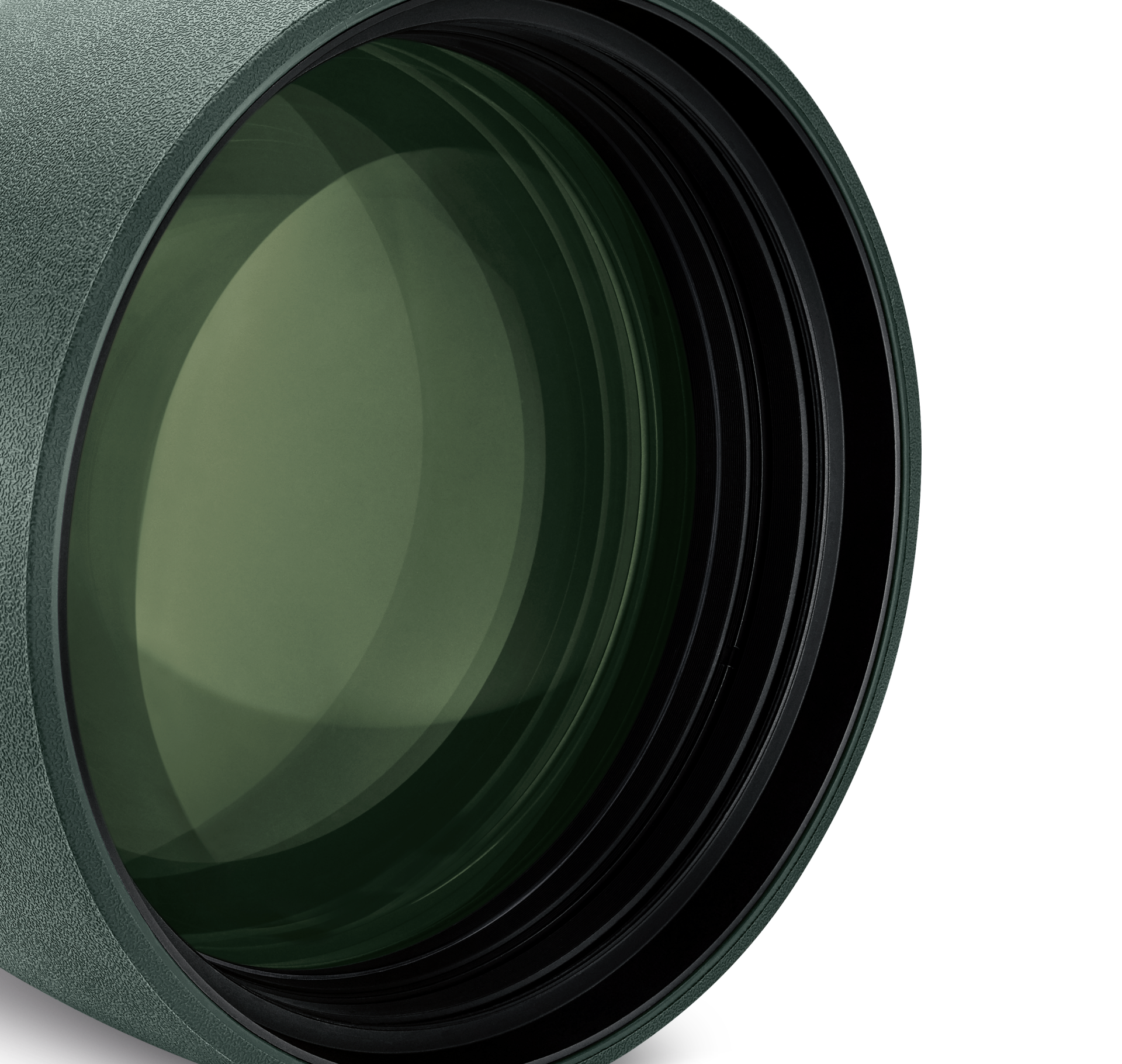
“THE BRIGHTNESS AND RICH CONTRAST OF THE 115-MM OBJECTIVE ALLOWS SUBTLE DIFFERENCES IN COLOURS TO BE DISTINGUISHED, EVEN ON DULL DAYS.”
We continued towards the beach to see what was flying further from shore. As we walked over the ridge of the dune we were buffeted by the strong south-westerly wind. A Meadow Pipit (Anthus pratensis) called as it shot past before diving into the grass on the leeward side of the dune. We found shelter just below the ridge, and although we were quite far from shore, we would benefit from the height of our viewing point.


“SEAWATCHING WITH THE 115-MM OBJECTIVE MODULE GIVES AN UNRIVALLED IMAGE ALLOWING DETAILS TO BE SEEN EVEN IN FLAT LIGHT.”


Intended Use
Shore Birding
What do I need to observe shorebirds, sea birds, and waterfowl?
Premium spotting scopes and binoculars which draw in all the light and deliver it with high magnification up to the tiniest detail. They will make it easier to get closer to the beautiful storm-petrels dancing on the waves far offshore or find that rare King Eider among a group of Common Eiders.