




What do the numbers 10x50 on binoculars mean? What is the relationship between magnification and field of view in binoculars and spotting scopes? And how can I identify high-contrast images? This overview of key terms and optical parameters opens up insights into the world of long-range optics.

MAGNIFICATION
Magnification is the factor by which an object appears closer than it actually is. Looking through the long-range optical device changes the perception – the higher the magnification, the closer the animal appears to be and the more details you can identify. However, high magnification means a smaller field of view.
MAGNIFICATION
Binoculars with a 10x magnification will optically magnify a bird that is 100 meters away, making it appear as if it is just 10 meters away if viewed with the naked eye. SWAROVSKI OPTIK binoculars are available with up to 12x magnification. Higher magnification would make handling more difficult, as well as hampering stable and steady observation through the Binoculars.
Thanks to perfect ergonomics and balance, today’s technologies and developments make it possible to achieve a stable and steadier image even with higher magnifications.
Our spotting scopes are available with magnifications from 20x.

Optics 101
VARIABLE MAGNIFICATION
Most spotting scopes have a variable magnification. This means that you can adjust the magnification flexibly within a certain range. In contrast to fixed magnification, it is possible to zoom from the lower value to the higher value. However, if the magnification increases, the field of view, i.e. the image that you see, becomes smaller. Pay close attention to the product name, as the number in front of the “x” specifies the magnification. 30-70x95 is an instrument with 30x to 70x magnification and an objective lens diameter of 95 mm.

Optics 101
OBJECTIVE LENS DIAMETER
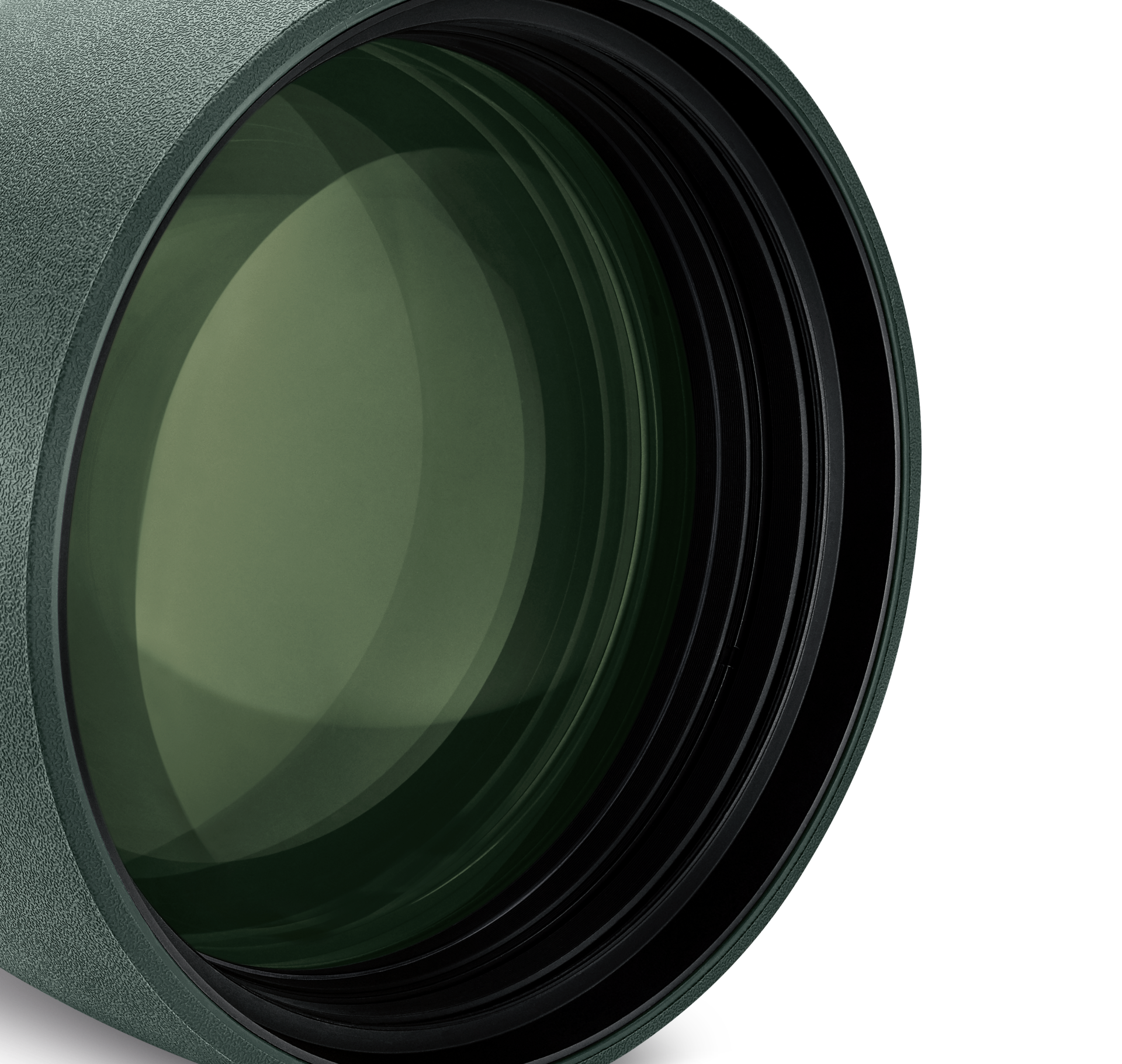
The Objective lens is – in contrast to the Eyepiece - the side of the long-range optical instrument facing the object. The Objective lens diameter determines how much light can enter the optics, which makes it a key factor in the instrument’s performance, especially in poor light conditions. This means: the larger the objective lens diameter, the more light the objective lens can capture and the lighter the image appears. The poorer the light conditions – for example, at twilight – the larger the objective lens diameter should be.
WHAT DO THE NUMBERS ON MY BINOCULARS OR SPOTTING SCOPE MEAN?
The product name for binoculars includes two numbers, or parameters, for example, 8x25, 10x32, or 12x42. The first of these numbers shows the magnification, e.g. 8x, 10x or 12x magnification. The second number shows the objective lens diameter in millimeters.
So in binoculars with the specification 10x42, the objective lens therefore has an optically effective diameter of 42 millimeters. We are talking here about universal binoculars that are still relatively compact in terms of size and weight, and bright enough to allow you to keep watching even in early twilight. Because the larger the objective lens, the more available light it can capture.

FIELD OF VIEW
The field of view is the section of the image that can be seen through the optics. As a rule of thumb: the higher the magnification, the smaller the field of view. Binoculars have a larger field of view in comparison to a spotting scope, which means you can see a large area. Spotting scopes have a higher magnification, which makes the field of view much smaller, but you can see more detail.
The size of the field of view is usually specified in meters at a range of 1,000 meters (3280 ft). Through binoculars with a field of view of 150/1000 m, the viewer will therefore see a 150 meter (492 ft) wide circular image at a range of 1,000 meters (3280 ft).
Field of view
Incorrectly, in movies, a view through binoculars is usually shown in the shape of a figure eight on its side. However, with high-quality binoculars that have been adjusted correctly, you can actually see a single circular image with no shadows.

EXIT PUPIL
If you look at the eyepiece from a certain distance, the exit pupil appears as a bright disc. The exit pupil is a value calculated based on the objective lens diameter/magnification . In high-quality binoculars, this is displayed perfectly and round.
FORMULA: Exit pupil = objective lens diameter/magnification
EXIT PUPIL
The larger the exit pupil, the more light reaches the eye. This is therefore very important for observing in poor light conditions.
Binoculars with the specification 8x56 have an exit pupil of 7 mm. This is compared to 8.5x42 binoculars, where the value is 4.9 mm.
EXIT PUPIL
We need to consider the maximum extent to which the pupil of the human eye can open. This is 8 mm for children, with flexibility decreasing as we get older.

TRANSMISSION
Light transmission is an important parameter to measure the transmission rate of an optical instrument. For example, a transmission value of 90% means that of the 100% light entering the objective lens, 90% reaches the eye. This is a physical principle caused by absorptions in the glass, as well as by reflections at glass-air boundaries.
TRANSMISSION
The Transmission is positively influenced by different coatings. Coatings – in other words surface finishes – are important on all glass-air boundaries to minimize loss of light through absorptions and reflections. The higher the quality of the coatings, the better the light transmission will be and the fewer distracting reflections will be captured by the optics – in particular in intense light.

Optics 101
SHORTEST FOCUSING DISTANCE
The shortest focusing distance specifies how close an object needs to be to see it clearly with the binoculars. From this value to infinity, you can use the focusing ring to focus the image. The shortest focusing distance for our binoculars starts at 2 meters (NL Pure). These values do not consider any visual impairments in the human eye.

Optics 101
INTERPUPILLARY DISTANCE
The interpupillary distance is the distance between the left and right eyes in millimeters – measured from pupil center to pupil center. In our binoculars, the interpupillary distance can be adjusted, depending on the model.

EYE RELIEF
The eye relief is the distance between eyepiece and human eye, and specifies where the exit pupil of the binoculars ideally meets the human eye. Twist-in eyecups can be used as a mechanical aid to adjust the individual position. The eye relief in high-quality binoculars is between 14 and 19 mm, which guarantees pleasant viewing.
EYE RELIEF
People wearing glasses should twist the eyecups in to compensate for the distance between the eye and the glasses.

Optics 101
DIOPTER ADJUSTMENT
The diopter adjustment is required to compensate for different visual impairments between the left and right eyes. If both eyes have equal vision (even if short- or long-sighted), or if wearing glasses, no adjustment is needed.

IMAGE QUALITY
The general image quality is also understood as the overall optical display performance. This is characterized by an optimum relationship between image definition, resolution and distortion (optical distortion of objects during image reproduction), and by a color-neutral, bright image.
IMAGE QUALITY
To test the quality of your binoculars, take a look at the stars. High-quality optics show the point-shaped light sources against a dark background as individual points and without dazzling.

Optics 101
BRIGHTNESS
As a basic rule: the larger the objective lens diameter, the more light passes through the optical system and therefore the exit pupil. At a higher magnification the exit pupil becomes smaller and, therefore, the brightness is reduced. In this case, it is a question of finding the ideal balance between size, weight, and brightness performance for the long-range optical device. One possible yardstick is the so-called Twilight factor. The higher the twilight factor, the more details are visible. The twilight factor is calculated from the root of magnification x objective lens diameter.
FORMULA: Twilight factor = magnification x objective lens diameter
The light intensity is calculated using the following formula: (objective lens diameter/magnification)^2

Optics 101
EDGE SHARPNESS
The Edge sharpness is a good indication of high-quality optics and can also be easily verified. The complete field of view should be sharp from the center of the image to the edge. Good, or even perfect, edge sharpness captures details all the way to the edge and avoids the need for continuous readjustment.

Optics 101
CONTRAST
The foundation for good CONTRAST is a clear image. Little color fringing, low spherical aberration, and perfectly tailored coatings increase the contrast in an optical system. Contrast is used to mean the sharp separation of light-dark transitions on an object. The sharper these transitions, the higher the contrast of the image.

DETAIL RECOGNITION
Being able to recognize fine details on an object is highly dependent on environmental conditions, such as light conditions and the object’s contrast, as well as the size of binoculars chosen.
DETAIL RECOGNITION
The fine structure of feathers is a good way to test the detail recognition of binoculars. The better the optics, the less yellow or blue color fringing you will see.

Optics 101
LIMITING RESOLUTION
Resolution is the ability of an optical system to separately reproduce the tiniest of details. The larger the objective lens diameter, the smaller the objects that can theoretically be identified.
SWAROVISION
With the development of SWAROVISION, SWAROVSKI OPTIK has gone a step further by redefining the concept of optical quality. It delivers unparalleled sharpness because the field flattener lenses provide an almost flat, completely distortion-free image – right up to the edges. SWAROVISION also stands for maximum optical performance with razor-sharp contours. And finally, the innovative lens coatings provide maximum color fidelity with excellent color rendering and high light transmission. All in all, high-contrast, and lifelike images are guaranteed. You won’t miss a single detail, making identification quick and easy
Would you now like to find out which binoculars are best for you and your requirements?
The product guide will quickly answer this question. Simply describe where, when, and for what purpose you want to use your long-range optical device and it will display the perfect recommendation.
What kind of product are you looking for?